What if the life you’ve built isn’t the life you truly want to live? Sometimes, everything looks right on paper, yet something inside tells you there’s another path worth exploring. For me, the journey from a secure career in IT and marketing to entrepreneurship and a new life on the Canary Islands has been about learning to navigate beyond the expected route. In this article, I share why finding your own way isn’t about abandoning security, but about having the courage to redefine success and create a life that feels like yours.


There comes a moment when you realize that, although you’re on the right boat, you might not actually be sailing in the direction you want to go. From the outside, everything looks good. You have a secure job, a solid education, you’re gaining experience, and you’re doing what people do when they’ve seemingly found their path in life. You’re on course. Or at least, you’re following the course you set out on at some point. And yet, there’s this quiet question in the back of your mind: Is this it? Or is there something else waiting for me out there?
I think many people know this feeling. They have an idea, a passion, or a vision of what their life could look like. But between the safety of the harbor and the open sea lie a lot of things: doubts, responsibilities, expectations, and the fear of making a mistake. I know this tension myself. And my journey has taught me that it’s not always about finding the next destination. Sometimes, it’s about recalibrating your own navigation system.
1. When Your Life Is on Autopilot
My journey initially took me through a degree in Business Administration and into the IT industry, where I spent more than ten years working in marketing. I learned a lot, worked on exciting projects, and developed skills that continue to serve me today. Looking back, none of that was a detour. Quite the opposite: much of what I do as an entrepreneur today has its roots in those experiences.
But beyond my professional journey, travelling through Africa and spending extended periods in different parts of the world also shaped my perspective on life. These experiences gave me the opportunity to step outside familiar routines, encounter different ways of living, and question some of the assumptions I had grown up with.
I began to realize that there isn’t just one blueprint for a successful life. The path that looks right on paper isn’t necessarily the one that feels right to you. At some point, I started asking myself a more fundamental question: How do I actually want to live and work?
We grow up with certain expectations. A good degree, a secure job, professional success — these are goals that can give us direction. And security isn’t a bad thing. It can provide stability and give us the space to grow. It only becomes a problem when we pursue these goals without questioning whether they’re really our own. That’s when life starts to feel like an airplane on autopilot. Everything is working, the route is programmed, and the next destination is already set. But who actually decided where the journey should take you? Maybe you chose this course consciously at some point. Maybe it simply happened along the way. Both are okay. But you can always step back into the cockpit.

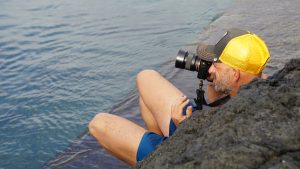
Playa de la Caleta - el lugar donde Christof tomó la decisión de quedarse
2. Taking the First Step Away from Safe Harbor
Since 2016, I’ve been building my own path through various projects and businesses. An important part of that journey was becoming self-employed and building my own creative agency. Suddenly, my role was no longer just about doing good work within an existing system. It was about creating something of my own, making decisions, and taking responsibility for the direction I wanted to go. That sounds like freedom. And it is.
But freedom doesn’t mean everything suddenly becomes easier. When you build something of your own, there isn’t a ready-made flight plan for every situation. You have to figure out which clients are right for you, which ideas have potential, and how to turn your skills into a viable business model.
Sometimes you have a tailwind. Sometimes you have to tack against the wind. And sometimes you discover that your original course simply doesn’t work. That’s part of the journey. I’ve learned that I don’t need to know all the answers before setting off. I need to be willing to learn along the way, reassess my decisions, and change course when necessary. Because the perfect moment — when every doubt has disappeared and every risk can be calculated — probably never comes.
You don’t need a perfect flight plan. You need a direction, a first step, and the willingness to learn along the way.
You don’t need a perfect flight plan. You need a direction, a first step, and the willingness to learn along the way.
Laura Jane Hoffmann | Founder | Passion Pilot
3. Sometimes, You Need to Change the Map
Travel has played an important role in how I see the world and the life I want to create. Travelling through Africa opened me up to new perspectives, while spending considerable time in Manaus, Brazil, working from the heart of the Amazon rainforest, showed me that work and life don’t necessarily have to fit into the conventional structures we’re used to.
Working remotely from such a different environment challenged the idea that professional life has to happen in a particular place or follow a predetermined routine. It made the relationship between work, freedom, and the environment around me feel much more tangible.
Of course, working from somewhere extraordinary doesn’t automatically mean you’ve figured everything out. But experiences like these can change the questions you ask yourself.
Instead of simply wondering how to build a successful career, I started thinking more about what success should actually look like for me — and how I could shape a life around the things that matter most.
Another important turning point in my journey was moving from Munich to the Canary Islands. A new place means more than a different address. It changes your everyday life, your perspective, and sometimes even the questions you ask yourself. On La Gomera, I deliberately created space for a new chapter. For me, it was about discovering how I could bring my interests, my work, and my life into closer alignment.
Alongside my entrepreneurial projects, I’ve been exploring my creative side in different ways. Teaching dance has become an important part of my life, allowing me to share movement, music, and expression with others. Over the past two years, I’ve also released two songs of my own — another step in exploring my creativity and bringing ideas that once lived in my head into the world.
These projects might seem quite different from my background in business, IT, and marketing. But to me, they’re all connected by the same desire: to create something meaningful, express myself, and explore what becomes possible when I give my interests the space to grow.
Why should I limit myself to a single role when different interests, experiences, and skills can combine to create something new?
Maybe your passion doesn’t need to become a business straight away. Maybe it’s initially an outlet, an experiment, or the beginning of an idea. But you can give it space without knowing exactly where it will lead. Sometimes, moving to a new island doesn’t simply take you somewhere else. It opens up a new perspective on the life you’ve been living.
4. Your Own Way of Life Doesn’t Need a Standard Flight Plan
When we talk about starting a business, we often think about the company first: the business idea, the business plan, the first customers, and perhaps eventually growth. All of that matters. But I think we should take another question just as seriously: What kind of life is this business actually supposed to make possible?
Do you want to build a large team or work independently? Do you want to be location-independent? Do you need creative freedom, financial predictability, or plenty of time for other interests? How much responsibility do you want to take on — and how much uncertainty can you realistically handle? There is no single right model. For some people, it’s the bold leap into full-time self-employment. For others, it’s a passion project alongside a regular job that gradually grows. And others discover that they’d rather pursue their passion outside their professional lives. All of these paths can be right.
My own journey hasn’t revolved around one big idea that I’ve simply pursued relentlessly. It’s developed through different projects, encounters, and experiences.
My work in marketing and technology, my creative side, and my entrepreneurial ventures all influence one another. I don’t have to squeeze every part of myself into a single box.
And perhaps that’s an important part of creating your own way of life: instead of asking which career path suits you, start asking what combination of work, interests, relationships, and lifestyle feels right for you. Not as a finished structure that has to last forever, but as something that is allowed to change as you grow.
You don’t need a perfect flight plan. You need a direction, a first step, and the willingness to learn along the way.
Laura Jane Hoffmann | Founder | Passion Pilot
5. You Don’t Have to Pull Up the Anchor Right Away
If you’re at a point where you want more from life, that doesn’t mean you need to quit your job, move abroad, or start a business tomorrow. You can be cautious. You can run the numbers, make plans, and weigh the risks. After all, a good captain doesn’t ignore the weather just because they’re eager to set sail. But you can start without leaving everything behind.
Talk to people who have already built something similar. Test your idea on a small scale. Develop a first prototype. Set aside regular time for the project you’ve been thinking about for so long. Find out whether it actually suits you — and whether it offers something valuable to other people. You don’t have to cross the entire ocean at once. Sometimes, a short first voyage is enough to discover whether you’re sailing in the right direction. And perhaps you’ll discover that you don’t need to travel as far as you thought. Maybe you don’t need an entirely new career, just more room to shape your own work. Maybe you don’t need your own business, but a creative project. Or perhaps you’ll realize that it’s genuinely time to cast off the lines. What matters is making that decision consciously. Not impulsively. But also not because you believe you have to stay in the harbor forever simply because it’s safe.
6. The Most Important Lesson of My Journey
When I look back on my journey so far, I don’t see a perfectly planned route from the starting point to the destination.I see different stages, decisions, encounters, and experiences that have shaped me. Some things turned out differently than I expected. Others opened doors I hadn’t even known existed. And many things I might once have considered detours have become part of my foundation today.
I’ve learned that I don’t need to know everything in advance. That security and freedom aren’t absolute opposites. And that I don’t have to leave my past experiences behind to build something new. I can take them with me.
Perhaps that’s the key difference between following a predetermined career path and creating your own way of life: you don’t have to know every stop along the way. You can change direction, discover new interests, and keep questioning your own definition of success. The safe harbor doesn’t become worthless because of that. It has protected you, prepared you, and allowed you to gain experience. But a harbor is also a starting point. And at some point, you get to decide whether you want to stay or explore something new.
You’re not obligated to keep living a life just because you once set a course for it. You’re allowed to navigate anew. Maybe it’s time to switch off the autopilot, step into the cockpit, and turn your eyes back toward the horizon. Not because you know exactly what’s waiting for you there.But because you want to find out what’s possible.
You’re not obligated to keep living a life just because you once set a course for it. You’re allowed to navigate anew.
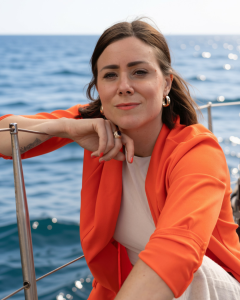
Laura Jane Hoffmann
Laura Jane Hoffmann es la fundadora de Passion Pilot. Después de trabajar más de diez años como Gerente de Marketing en la industria de TI, ahora dirige su propia agencia de marketing creativo, hace música y trabaja como instructora de baile y fitness. Passion Pilot es su proyecto del corazón. Junto con su red de fundadores y artistas, quiere apoyar a personas de todo el mundo a encontrar su pasión a través de la creatividad, descubriendo las herramientas para ejecutar sus ideas y comenzar su propio negocio.